
The Unruled Self
On Akrasia, the Will, and the Ruin of Those Who Know Better

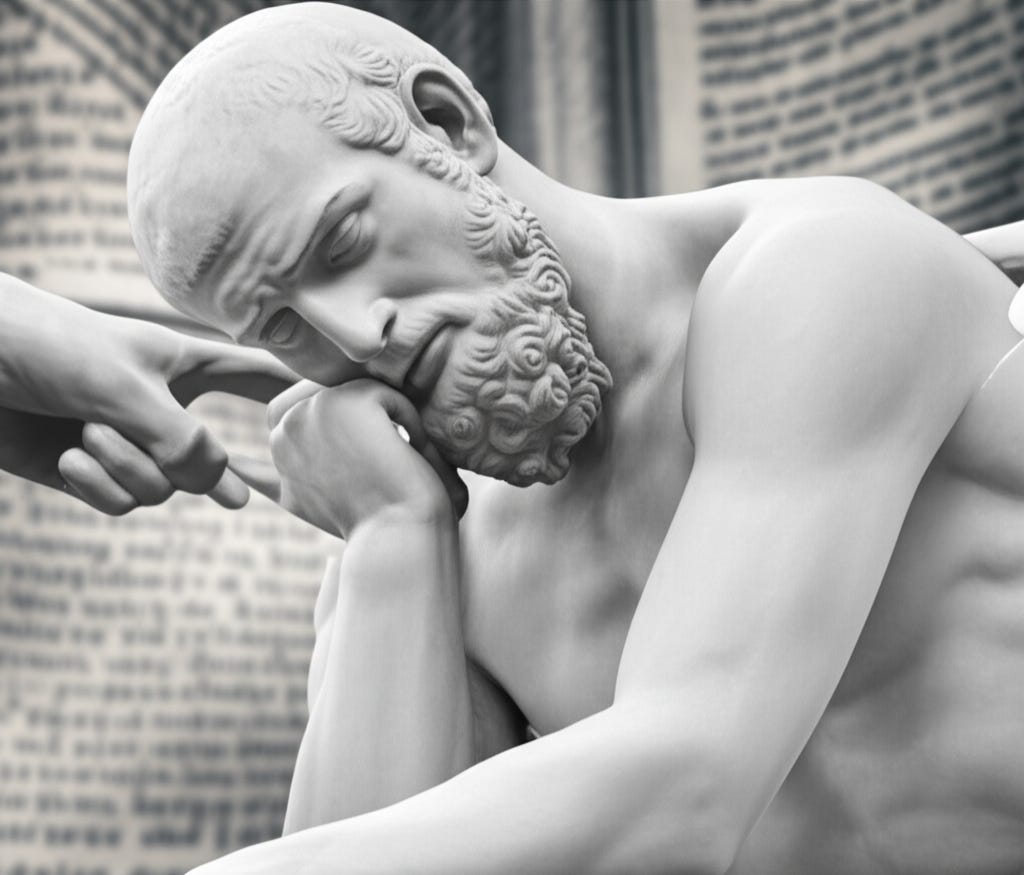
I. THE OLDEST ARGUMENT ABOUT HUMAN FAILURE
Socrates, as rendered by Plato in the Protagoras, commits himself to a position that strikes most people as obviously false and yet proves impossible to dismiss easily. He argues that no one does wrong willingly. If a man knows the good, he will pursue it; if he pursues what is harmful, it is because he does not truly know it to be harmful. What looks like weakness of will is, in the Socratic account, always a failure of knowledge. The person who eats ruinously, who drinks past reason, who betrays a friendship for a night of vanity, does not, in Socrates' reckoning, know in any genuine sense that these things are bad for him. He is mistaken about his own good. He is, at the moment of choosing, simply wrong.
This is a remarkable position because it is simultaneously the most charitable interpretation of human failure and the most devastating. Charitable, in that it refuses to call the person wicked. Devastating, in that it denies him the one thing he most wants to claim about himself: that he is self-aware, that he sees clearly, that he knows what he is doing even as he does it. The Socratic view offers absolution and removes dignity in the same motion.
Aristotle, writing in the Nicomachean Ethics roughly a century later, found this account insufficient. He took up the problem of akrasia — the Greek word for what we call weakness of will, though it means literally "without command," without self-rule — and treated it with the seriousness it deserves. He agreed with Socrates that the phenomenon is philosophically puzzling. He disagreed that it is impossible. His argument is careful and worth following closely, because it remains the most penetrating description of what happens inside a person in the moment he chooses the worse course.
Aristotle's akratic agent is not ignorant. He knows the better course in the universal sense — and still does not apply it.
Aristotle distinguishes between having knowledge and actively using it. A man may know in the universal register that excessive drink is harmful. He may even affirm this sincerely. At the moment a cup is placed before him, however, the particular judgment — the recognition that this cup, now, in this moment, is covered by the general prohibition — can be suppressed or overwhelmed by appetite. He reaches for it. He is not confused about the general principle. He simply fails to bring it to bear on the particular case, because desire has occupied the space where practical judgment ought to stand.
This distinction, between universal knowledge and particular application, is among the subtlest pieces of moral psychology in ancient philosophy. It explains something that Socrates' account cannot: the experience of watching yourself do what you know you should not do, in full awareness, with a kind of helpless clarity about what is happening. Every reflective person recognises this experience. Aristotle names it, analyses it, and refuses to explain it away.
II. THE WORD AND WHAT IT COVERS
Akrasia, in its technical Aristotelian usage, refers specifically to the condition of an agent who acts against his own better judgment under the influence of appetite or passion. It is a narrower concept than self-deception though the two are related. The self-deceived person has falsified his own knowledge; the akratic person's knowledge remains intact. It is also distinct from incontinence in the habitual sense, what Aristotle calls akolasia, where appetite has so thoroughly colonised judgment that the agent no longer even registers the conflict. The akratic person still feels the conflict. That is precisely what makes his situation philosophically interesting and personally excruciating.
Aristotle further distinguishes between two species of akrasia. The first is propeteia, which might be translated as impetuosity or rashness — a condition in which the agent acts before deliberation has had time to complete itself. Appetite rushes ahead of reason. The second is astheneia, genuine weakness, in which deliberation occurs, the better course is identified, and the will nevertheless fails to execute it. The impetuous person is perhaps more forgivable; reason never got its full hearing. The weak person is in a more troubling condition: he heard, he understood, and he did not act on what he understood.
These are not merely academic categories. Any adult who thinks carefully about his own patterns of failure will recognise which species most often afflicts him. Some people fail because they do not pause; they would choose better if they would only slow down long enough for judgment to speak. Others pause, judge correctly, and then do the wrong thing anyway. The second group has the harder problem, and it is the second group for whom the ancient analysis cuts deepest.
III. AUGUSTINE, THE DIVIDED WILL
Augustine of Hippo, writing in the Confessions in the late fourth century, brought the problem into a different register. His famous prayer — "Lord, make me chaste, but not yet" — is often quoted for its wit. It deserves more serious attention as phenomenology. What Augustine describes is not a simple preference for pleasure over virtue. It is the experience of willing two incompatible things simultaneously, of wanting to be different from what one is while also, at some level, not wanting to pay what transformation costs.
He calls this the voluntas divisa, the divided will. Two wills contend within a single person. The will that wishes to be free of a habit and the will that does not wish to surrender the habit are both genuine. The person is not pretending to want the better thing; he genuinely wants it. He also genuinely wants the worse thing. The conflict is real, the paralysis is real, and the resolution — when it comes — is not, in Augustine's account, achieved by argument or by willpower in the ordinary sense. It comes by grace, by a gift from outside the economy of human striving.
The person is not pretending to want the better thing. He genuinely wants it. He also genuinely wants the worse thing. The conflict is real.
Whether or not one accepts the theological framework, Augustine's psychological description has never been surpassed for precision. He captures what so many philosophical accounts miss, which is that the will is not a simple faculty that either functions or fails. It can be genuinely split, genuinely at war with itself, producing a person who is, in a sense, two people inhabiting the same body and the same life. This is a more unsettling picture than Aristotle's, because Aristotle's account at least preserves the unity of the person. Augustine suggests that the unity itself is what is at stake.
IV. THE ENLIGHTENMENT AND AFTER
Kant, approaching the problem from the architecture of his moral philosophy, places akrasia within a broader account of the conflict between practical reason and pathological motivation. For Kant, the moral law requires that reason hold absolute dominion over action, untempered by the solicitations of inclination. The man who acts from desire rather than duty cannot, in the fullest moral sense, be said to act freely; he remains subject to his empirical nature, borne along by impulses he has failed to bring under the authority of rational self-legislation. Akrasia thus appears as something graver than a lapse of resolve. It marks a forfeiture of freedom at its deepest and most essential level.
Kant is too austere to be a comfortable guide here, but he points at something important. The capacity to govern one’s own conduct is no mere practical accomplishment; it belongs to the very constitution of moral agency itself. A person who cannot reliably act in accordance with his own considered judgments suffers from more than simple ineffectiveness. His self-command is diminished alongside the fullness of his moral freedom. He retains the outward character of a free agent, yet lacks something of its inward substance.
Later philosophy has complicated these accounts without displacing them. Hume argued that reason is and ought to be the slave of the passions, that motivation requires desire and reason merely identifies the means. This has always seemed more descriptively accurate than normatively helpful. The fact that desire does much of the work in producing action does not settle the question of what a person ought to do when his desires conflict with his considered judgments. Freud gave the problem a new vocabulary — the id, the superego, repression, the return of the repressed — without fundamentally altering the structure of the dilemma. Contemporary psychology has contributed the language of dual-process cognition: System 1, fast and associative; System 2, slow and deliberative. Akrasia, in this framework, is the failure of System 2 to override System 1 when it ought to. The terminology changes but the problem remains.
V. WHY THE ADULT MUST RECKON WITH THIS
The concept of akrasia is not one that children need to be taught about themselves, because the expectation of consistent self-command is not yet placed on children. Society, rightly, makes allowances for the developing capacity for self-regulation. The child who cannot resist the sweet, who cannot delay gratification, who acts on impulse before reflection has had time to form — this is a child behaving as children do. The work of growing up is, in large part, the work of acquiring what the Greeks called enkrateia: self-command, the capacity to act from one's own best judgment rather than from the loudest impulse of the moment.
Adulthood, on almost any serious account, is the condition in which this capacity is supposed to be operative. An adult is, by definition, someone who has enough experience of consequences, enough reflective distance on his own tendencies, and enough stable commitment to his stated values, to close the gap between knowing and doing. The troubling reality is that this transition never completes itself in most people. They carry their akratic tendencies forward into adult life, dressed now in more sophisticated excuses, given more respectable framings, but structurally identical to what they were at fifteen.
What adulthood demands, and what akrasia defeats, is not better intentions but a closing of the gap between intention and act.
This matters, first, because self-knowledge and self-governance are not the same thing and the confusion between them is a source of enormous waste. A person who knows, in great detail, the ways in which he fails — who has read the philosophy, who has done the therapy, who can name his patterns with clinical precision — is not thereby a person who has overcome those failures. Knowledge, as Aristotle understood and Socrates denied, does not automatically translate into action. The person who understands exactly why he procrastinates and continues to procrastinate has not solved his problem; he has merely described it with greater sophistication. Self-knowledge without self-command is a kind of luxury item, pleasant to own and useless at the moment of need.
It matters, second, because akrasia compounds. Each time a person acts against his own better judgment, he slightly diminishes the felt authority of that judgment the next time. This is Aristotle's point about the movement from akrasia toward vice: the incontinent person who continues to act badly does not remain in a state of ongoing conflict forever. He moves, gradually, toward a condition in which the conflict no longer registers, because desire has so thoroughly reshaped his perception that the worse choice now seems obviously correct. The vice-ridden person is no longer akratic in the precise sense. He is simply wrong about what is good, having arrived at that wrongness through a long sequence of small capitulations. Akrasia, left to run its course, is the entrance ramp to a kind of moral blindness.
It matters, third, because integrity in etymology— from the Latin integritas, wholeness — requires that a person's stated values and his actual choices occupy the same world. The person who says he values his work and cannot begin it, who says he values his health and will not tend it, who says he values honesty and qualifies it away in each particular case, is a person whose self-concept and whose life have come apart. This is no tragedy in the ancient mould, which requires a figure of consequence brought low through some singular and fatal defect. It is of a quieter and more insidious order: a diffuse life, a life without a spine, in which the self one claims to be and the self one actually is have become strangers to each other.
VI. ON THE STRUCTURES OF SELF-COMMAND
The ancient corrective to akrasia was not argument but habituation. Aristotle is explicit on this: virtue is acquired by practice, not by instruction. The person who wants to be courageous must perform courageous acts, even before he feels courageous, so that the performance gradually reshapes the character from which future acts will flow more naturally. The will is not strengthened by being convinced; it is strengthened by being exercised. This means that the path out of is the construction of better habits, and the construction of better habits requires something more uncomfortable than reading, it requires repeated action against the grain of one's current inclinations.
The Stoics, and Epictetus most sharply among them, understood the practical implications of this. The Stoic project for example, learned to distinguish between what is within one's power and what is not, and then actually choosing within the domain of one's power rather than being carried about by the things outside it. Epictetus had been a slave. He knew something about the difference between external constraint and internal freedom, and he insisted that the second was available even when the first was absolute. His lectures were not mere philosophical entertainment but rather, exercises in practical self-command, conducted in the knowledge that philosophy which does not change the way one lives is merely a more expensive form of idleness.
What this suggests for anyone who takes the problem seriously is that the relevant intervention is structural before it is psychological. One does not overcome akrasia primarily by willing more strongly in the moment of temptation; one overcomes it by arranging one's life so that the moment of temptation is less frequently reached, and by building commitments that remain operative even when the will is, as it will sometimes be, weakened. Ulysses knew he could not resist the Sirens and had himself tied to the mast. This is wisdom of a high order, the wisdom of a person who has made an accurate assessment of his own akratic tendencies and acted in advance of them rather than after.
The Ulysses move — binding oneself before the temptation arrives — is not weakness. It is the most honest form of self-knowledge translated into action.
The adult who has not seriously confronted the structure of his own akrasia is one who has confused the aspiration to virtue with its possession. He knows what he should do. He knows why he should do it. He has, perhaps, strong feelings about the importance of doing it. He does not do it, or does not do it consistently, and he has not yet asked the more difficult question: not why should I do this, but what arrangement of my life will make it more probable that I actually will?
VII. THE MIRROR AND THE DEMAND
Akrasia has always been uncomfortable to discuss honestly because it refuses the consolations that most accounts of human failure offer. It is the history of one who cannot plead ignorance, but must answer for the sorrowful disparity between judgment and deed. He knew the better course, and yet did not take it. This removes the most common exit from moral responsibility, which is ignorance. The akratic person has been given the knowledge. What he has not been given, or has not built, is the will to act on it.
To take this seriously is to accept a demanding picture of what personal development actually requires. It is not enough to read widely, to hold sophisticated views, to be persuaded by good arguments and capable of articulating them. These are necessary things, but they are not sufficient. The person who can explain, in philosophically precise terms, exactly why he ought to exercise more discipline in his work, and who continues to exercise none, has accomplished a kind of performance of virtue without its substance. The Greeks had a word for this too: they called it arete, excellence, and they understood it to be something expressed in action or not at all.
The honest reckoning that akrasia demands of anyone who wishes to be genuinely self-governing is this: identify the gap between your knowledge and your action, take that gap seriously as a structural feature of your character rather than an accident of circumstance, and build the habits, commitments, and external structures that narrow it. This is not going to be a heroic programme. It is not glamorous. It looks, in practice, like the daily management of one's own tendencies toward avoidance, delay, self-indulgence, and the thousand small rationalizations that allow a person to feel that he is doing something while not doing the thing he knows he should do.
The philosophers who have thought most carefully about this problem converge on one uncomfortable point and which is that the self is not given. It is made. The person one becomes is fashioned less by intention than by habit, less by professed conviction than by the quiet succession of choices through which a life is daily wrought. What a man declares himself to believe, and even what he aspires to value, are but uncertain auguries beside the steady testimony of his repeated acts. Character is accumulated by degrees, gathered across years, each decision adding its imperceptible weight, compounding alike toward elevation or decline. This is the gravity of akrasia. Every occasion on which one chooses the worse course, knowing it to be worse, is an occasion on which one becomes, in some small but real measure, a person who chooses the worse course. The pattern is built by its own repetition.
Conversely, every occasion on which one acts from one's best judgment — especially against the resistance of appetite, inertia, or fear is an occasion on which one becomes, in the same incremental way, a person more capable of doing so again. Aristotle's optimism, if it can be called that, implies that character is not fixed. The akratic person is not condemned. He can, by sustained practice, move toward enkrateia, toward genuine self-command. The movement is neither quick nor guaranteed. It requires exactly the kind of sustained effort that akrasia makes difficult. This is the difficulty, and also the point.
A nice read. Thanks for this.
great read...thanks you, Adeseto